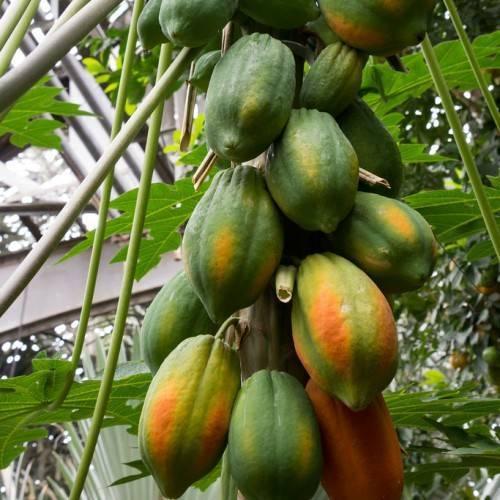
If you have ever planted papaya trees from seed, you have probably asked yourself one important question. Which tree will produce fruits? It is a question many farmers ask after patiently caring for their trees for several months, only to discover that some never produce a single papaya.
The good news is that papaya trees reveal their gender once they start flowering. Knowing how to identify male, female, and hermaphrodite papaya plants can help you manage your orchard better and enjoy higher yields.
At New Leaf Seedlings, we often advise farmers that understanding your papaya trees is just as important as choosing quality seedlings. A little knowledge can save you time, space, and money.
Why Papaya Plant Gender Matters
Unlike many fruit trees, papaya plants do not all produce fruit in the same way. Some trees produce only male flowers, some produce only female flowers, while others produce flowers that contain both male and female parts.
If your orchard has mostly male plants, you may end up with very few fruits. Learning to identify each type allows you to remove unnecessary trees and keep the productive ones.
How to Identify Male Papaya Plants
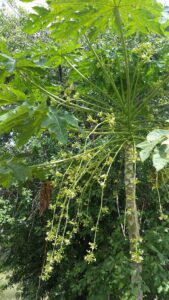
Male papaya trees are the easiest to identify because their flowers grow in long hanging clusters that extend away from the trunk.
Each cluster carries dozens of small cream or white flowers. These flowers are mainly responsible for producing pollen and do not usually develop into fruits.
A healthy male papaya tree can produce hundreds of flowers, but after they dry up, no fruits appear.
Characteristics of Male Papaya Trees
- Long, hanging flower stalks
- Many small flowers growing together
- Flowers appear some distance away from the trunk
- Usually do not produce fruits
Male trees are useful because they provide pollen that helps female flowers develop fruits. However, only a few male trees are needed in an orchard.
How to Identify Female Papaya Plants
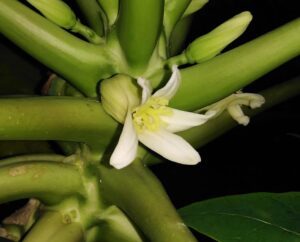
Female papaya trees produce larger flowers that grow close to the trunk instead of hanging on long stems.
The flowers are fewer but much bigger than those of male trees. Once pollinated, each flower develops into a papaya fruit.
If pollination is poor, female flowers may fall off without producing fruit.
Characteristics of Female Papaya Trees
- Large flowers growing close to the stem
- Usually one to three flowers at each point
- Flowers are thick and waxy
- Develop into fruits after successful pollination
Female trees depend on pollen from male or hermaphrodite trees to produce a good harvest.
How to Identify Hermaphrodite Papaya Plants
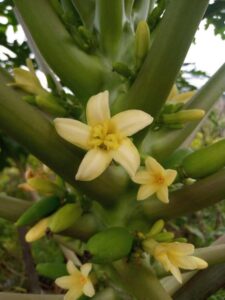
Hermaphrodite papaya plants are the most valuable for commercial farming because each flower contains both male and female reproductive parts.
These trees can pollinate themselves, reducing the need for separate male trees.
Their fruits are usually longer or pear shaped, which many consumers prefer because they have a smaller seed cavity and more edible flesh.
Characteristics of Hermaphrodite Papaya Trees
- Medium sized flowers
- Flowers grow close to the trunk
- Can pollinate themselves
- Produce elongated or pear shaped fruits
- Highly preferred for commercial production
When Can You Tell the Difference
Most papaya plants begin flowering about five to eight months after planting, depending on the variety, weather, and management.
Before flowering, it is almost impossible to tell whether a papaya plant is male, female, or hermaphrodite simply by looking at the leaves or stem.
This is why many farmers plant more seedlings than they actually need and later remove the excess male plants once flowering begins.
How Many Male Trees Should You Keep
If you are growing traditional papaya varieties, you only need one healthy male tree for every eight to ten female trees to ensure good pollination.
Keeping too many male trees wastes valuable space that could be occupied by fruit producing trees.
If you are planting hermaphrodite varieties, you may not need male trees at all because the plants can pollinate themselves.
The Best Way to Avoid Too Many Male Trees
One of the easiest ways to improve your chances of getting productive trees is to start with quality seedlings from a trusted nursery.
At New Leaf Seedlings, we guide farmers on selecting suitable papaya varieties and provide healthy seedlings that give your orchard the best possible start.
Healthy seedlings establish faster, grow vigorously, and help farmers build productive orchards with greater confidence.
Final Thoughts
Watching your papaya trees flower for the first time is exciting, but it is also the moment you discover which plants will reward your hard work with fruits.
By learning to identify male, female, and hermaphrodite papaya plants, you can make better decisions about your orchard, improve pollination, and increase your harvest.
Every productive papaya orchard begins with the right knowledge and healthy planting material. With proper planning and quality seedlings from New Leaf Seedlings, you can enjoy healthy trees and abundant harvests for years to come.